Cracking The Code: ND and their Taxpayers Still Having Different Conversations
A recent article in the North Dakota Monitor tells a different story to some. It shows that North Dakota isn’t simply dealing with a policy disagreement. It is dealing with a conversation gap so wide that the two sides may as well be speaking different languages. What the state describes as an economic or regulatory issue, landowners understand as a constitutional and ethical one — and the ruling only amplified how far apart those realities have drifted.
On one side: landowners, talking about rights, transparency, and constitutional limits.
On the other: the state and its public-private partners, talking about timelines, subsidies, and economic projections.
The court ruling didn’t create this divide.
It illuminated it.
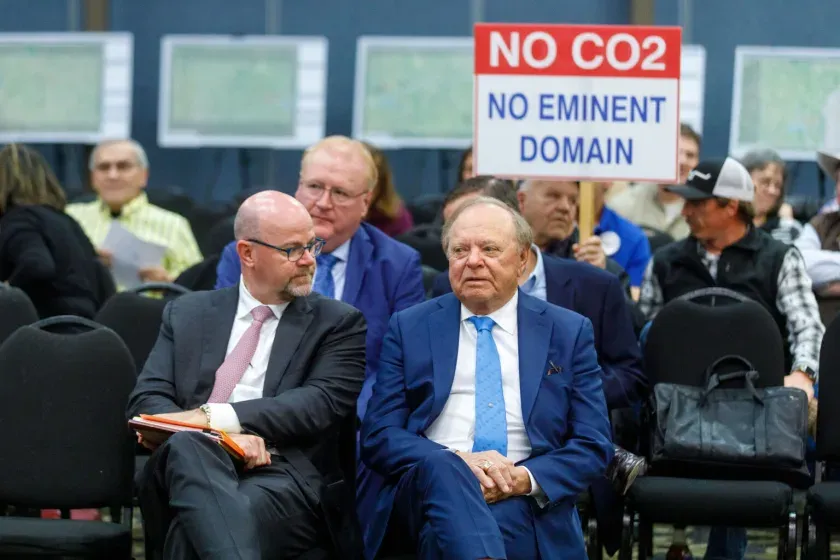
Dan Pickering of Pickering Energy Partners, left, and Harold Hamm of Continental Resources wait for a Public Service Commission hearing to begin on April 22, 2024, in Mandan. Behind, a pipeline opponent displays a sign before the hearing administrator asked him to put it down. Kyle Martin / For the North Dakota Monitor
Landowners Are Talking About Rights – The State Is Talking About Revenue
- consent,
- compensation,
- constitutional protection,
- due process,
- and government neutrality.
These are foundational questions.
But the state and industry keep responding with operational ones:
- “We need certainty.”
- “We need speed.”
- “We need to stay competitive.”
- “We need to secure federal dollars.”
Those aren’t answers — they’re objectives.
One side is talking about how government should behave.
The other is talking about how fast revenue can flow.
It’s no wonder everything is breaking down.
Is the State Trying to Legalize the Gray Area?
Look closely at the way state officials reacted to the ruling:
they’re not defending the ethics or necessity of forced pore-space access.
They’re defending the mechanics.
They’re asking:
“How can we rewrite this law so we can still do the thing the court says we did wrong?”
That is not a discussion about justice.
That is a discussion about legalizing a workaround.

It invites a hard, unavoidable question:
Is North Dakota trying to make private-benefit takings constitutional by adjusting the fine print rather than addressing the core problem?
When a private company stands to profit from a federally subsidized pipeline system, and the state’s role becomes smoothing the rough edges of property law, people naturally start talking about backroom deals and conflicts of interest — not because they’re paranoid, but because the incentive structure itself is now visible.
And here’s the brutal economic truth:
In this model, 45Q credits are worth more than mineral rights ever were.
That single fact explains more than any press release ever will.
Let’s repeat that one more time — because it is the structural key to the entire conflict: The government created a system where 45Q credits are worth more than mineral rights — and those credits are being steered to select companies through political channels.

The Economic Threat Narrative Is a Tell
Industry leaders immediately warned that the ruling would:
- disrupt carbon projects,
- stall the economy,
- undermine grid reliability,
- jeopardize investment.
But that argument unintentionally reveals the weakness of the entire architecture.
If your business model collapses the moment landowners gain constitutional protections, then your business model wasn’t rooted in market forces to begin with.
It was rooted in:
- eminent-domain shortcuts,
- regulatory primacy,
- political gatekeeping,
- and federal subsidies.
That’s not anything economically healthy.
That’s a state-supported revenue machine.
And it only runs smoothly when no one asks questions.

Ron Ness, center, president of the North Dakota Petroleum Council, listens Dec. 21, 2023, during a Public Service Commission hearing. To his right is Harold Hamm, executive chairman of Continental Resources. (Photo by Kyle Martin for the North Dakota Monitor)
PPPs, Lobbyists, and Politicians Really Did Paint Themselves Into a Corner
The Summit Carbon saga didn’t just expose a specific project.
It exposed a system that assumed compliance.
It assumed:
- landowners wouldn’t fight,
- regulators wouldn’t be challenged,
- courts wouldn’t intervene,
- and the public wouldn’t understand the stakes.
It was a political blueprint built on speed, silence, and subsidy — not transparency, consent, or constitutional rigor.

And now, the people inside that framework are trying to spin their way out.
But you can’t spin your way out of something that was engineered incorrectly from the start.
This isn’t villainy.
It’s hubris.
The belief that the government can out-engineer the free market without consequences.
Those consequences have arrived.

Landowners Aren’t the Problem. They’re the Warning.
- the process lacked transparency,
- the compensation wasn’t fair,
- the exemptions were too broad,
- the regulatory structure was too cozy,
- the PPP model was too insulated from public scrutiny.
They were treated as obstacles, troublemakers, even enemies of progress.
But this ruling proves something fundamental:
The landowners were not blocking the system — they were diagnosing it.They were reacting to an action thrust upon them, a kind of passive-aggressive political shock-and-awe engineered to overwhelm rather than inform.
Their objections weren’t ideological.
They were constitutional.
The courts finally heard them.
Continue reading: