The Ultimate Guide to Understanding Carbon Credits
Undated article from Carboncredits.com

from: https://carboncredits.com/the-ultimate-guide-to-understanding-carbon-credits/?fbclid=IwY2xjawNab-xleHRuA2FlbQIxMQABHqRqjgp2IsxwuIld0sbmVjinPCJ5dgftxiH13Sphi8eArfAAI0evoNKh_vQ6_aem_TTyV4vRYvSIOLH24aJg5cg#15
Carbon Markets 101
A carbon market allows investors and corporations to trade both carbon credits and carbon offsets simultaneously. This mitigates the environmental crisis, while also creating new market opportunities.
New challenges nearly always produce new markets, and the ongoing climate crisis and rising global emissions are no exception.
The renewed interest in carbon markets is relatively new. International carbon trading markets have been around since the 1997 Kyoto Protocols, but the emergence of new regional markets has prompted a surge in investment.
California continues to lead with its cap-and-trade program, while the Regional Greenhouse Gas Initiative (RGGI) includes 11 northeastern states.
The advent of new mandatory emissions trading programs and growing consumer pressure have driven companies to turn to the voluntary market for carbon offsets. Changing public attitudes on climate change and carbon emissions has added a public policy incentive. Despite an ever-shifting background of state, federal, and international regulations, there’s more need than ever for companies and investors to understand carbon credits.
This guide will introduce you to carbon credits and outline the current state of the market. It will also explain how credits and offsets work in currently existing frameworks and highlight the potential for growth.
1. Carbon Credits, Offsets and Markets – An Introduction
The Kyoto Protocol of 1997 and the Paris Agreement of 2015 were international accords that laid out international CO2 emissions goals. With the latter ratified by all but six countries, they have given rise to national emissions targets and the regulations to back them.
With these new regulations in force, the pressure on businesses to find ways to reduce their carbon footprint is growing. Most of today’s interim solutions involve the use of the carbon markets.
What the carbon markets do is turn CO2 emissions into a commodity by giving it a price.
These emissions fall into one of two categories: Carbon credits or carbon offsets, and they can both be bought and sold on a carbon market. It’s a simple idea that provides a market-based solution to a thorny problem.
2. What Are Carbon Credits and Carbon Offsets?
The terms are frequently used interchangeably, but carbon credits and carbon offsets operate on different mechanisms.
Carbon credits, also known as carbon allowances, work like permission slips for emissions. When a company buys a carbon credit, usually from the government, they gain permission to generate one ton of CO2 emissions. With carbon credits, carbon revenue flows vertically from companies to regulators, though companies who end up with excess credits can sell them to other companies.
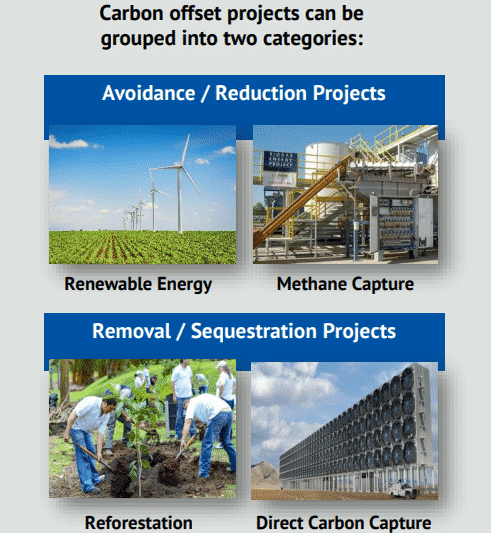
Offsets flow horizontally, trading carbon revenue between companies. When one company removes a unit of carbon from the atmosphere as part of its normal business activity, it can generate a carbon offset. Other companies can then purchase that carbon offset to reduce their own carbon footprint.
Note that the two terms are sometimes used interchangeably, and carbon offsets are often referred to as “offset credits”. Still, this distinction between regulatory compliance credits and voluntary offsets should be kept in mind.
3. How Are Carbon Credits and Offsets Created?
Credits and offsets form two slightly different markets, although the basic unit traded is the same – the equivalent of one ton of carbon emissions, also known as CO2e.
It’s worth noting that a ton of CO2 does refer to a literal measurement of weight. Just how much CO2 is in a ton?
- The average American generates 16 tons of CO2e a year through driving, shopping, using electricity and gas at home, and generally going through the motions of everyday life.
To further put that emission in perspective, you would generate one ton of CO2e by driving your average 22 mpg car from New York to Las Vegas.
Carbon credits are issued by national or international governmental organizations. We’ve already mentioned the Kyoto and Paris agreements which created the first international carbon markets.
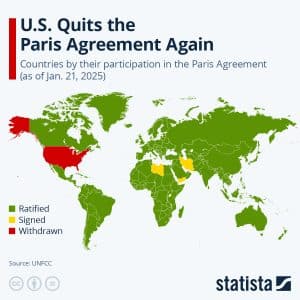
In the U.S., California operates its own carbon market and issues credits to residents for gas and electricity consumption.
The number of credits issued each year is typically based on emissions targets. Credits are frequently issued under what’s known as a “cap-and-trade” program. Regulators set a limit on carbon emissions – the cap. That cap slowly decreases over time, making it harder and harder for businesses to stay within that cap.
Around the world, cap-and-trade programs exist in some form in many countries, including Canada, the EU, the UK, China, New Zealand, Japan, and South Korea, with many more jurisdictions considering implementation.
As of 2024, carbon pricing initiatives operate in 46 national jurisdictions and 37 subnational jurisdictions. Recent additions include Indonesia’s carbon trading scheme launched in late 2023, Vietnam’s pilot program initiated in 2024, and Malaysia’s emissions trading system planned for early 2025. Together, these markets cover approximately 23% of global greenhouse gas emissions.
Companies are thus incentivized to reduce the emissions their business operations produce to stay under their caps.
In essence, a cap-and-trade program lessens the burden for companies trying to meet emissions targets in the short term and adds market incentives to reduce carbon emissions faster.
Carbon offsets work slightly differently…
Organizations with operations that reduce the amount of carbon already in the atmosphere, say by planting more trees or investing in renewable energy, have the ability to issue carbon offsets. The purchase of these offsets is voluntary, which is why carbon offsets form what’s known as the “Voluntary Carbon Market”. However, by buying these carbon offsets, companies can measurably decrease the amount of CO2e they emit even further.
4. What is the Carbon Marketplace?
When it comes to the sale of carbon credits within the carbon marketplace, there are two significant, separate markets to choose from.
- One is a regulated market, set by “cap-and-trade” regulations at the regional and state levels.
- The other is a voluntary market where businesses and individuals buy credits (of their own accord) to offset their carbon emissions.
Think of it this way: the regulatory market is mandated, while the voluntary market is optional.
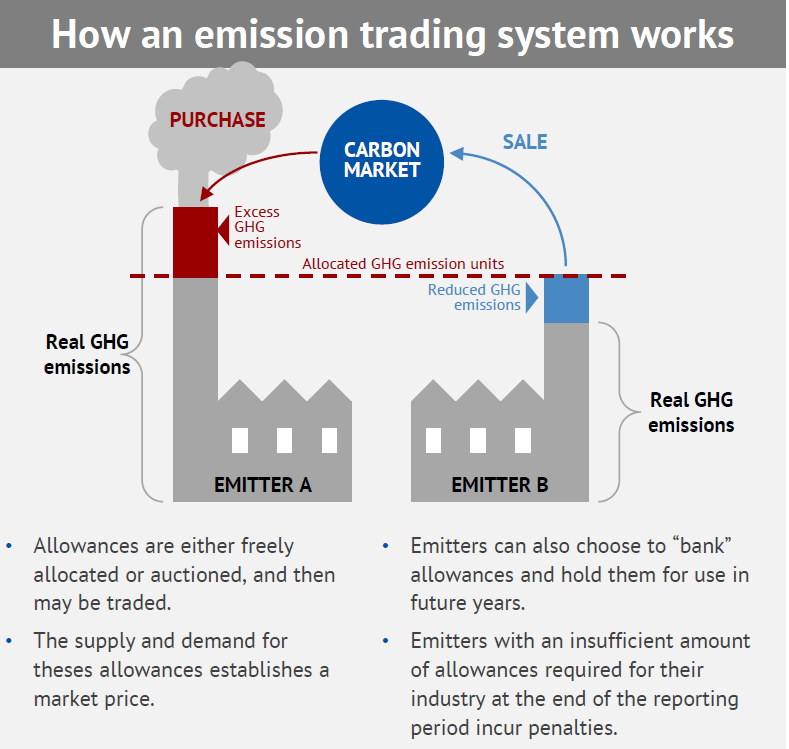
When it comes to the regulatory market, each company operating under a cap-and-trade program is issued a certain number of carbon credits each year. Some of these companies produce less emissions than the number of credits they’re allotted, giving them a surplus of carbon credits.
On the flip side, some companies (particularly those with older and less efficient operations) produce more emissions than the number of credits they receive each year can cover. These businesses are looking to purchase carbon credits to offset their emissions because they must.
Most major companies are doing their part and will or have announced a blueprint to minimize their carbon footprint. However, the amount of carbon credits allocated to them each year (which is based on each business’s size and the efficiency of their operations relative to industry benchmarks)., may not be enough to cover their needs.
Regardless of technological advances, some companies are years away from reducing their emissions substantially. Yet, they still have to keep providing goods and services in order to generate the cash they need to improve the carbon footprint of their operations.
As such, they need to find a way to offset the amount of carbon they’re already emitting.
Here’s an example:
Let’s say two companies, Company 1 and Company 2, are only allowed to emit 300 tons of carbon.
However, Company 1 is on track to emit 400 tons of carbon this year, while Company 2 will only be emitting 200 tons.
To avoid a penalty comprised of fines and extra taxes, Company 1 can make up for emitting 100 extra tons of CO2e by purchasing credits from Company 2, which has extra emissions room to spare due to producing 100 tons less carbon this year than they were allowed to.
The Difference between the Voluntary and Compliance Markets
The voluntary market works a bit differently. Companies in this marketplace have the opportunity to work with businesses and individuals who are environmentally conscious and are choosing to offset their carbon emissions because they want to. There is nothing mandated here.
It might be an environmentally conscious company that wants to demonstrate that they’re doing their part to protect the environment. Or it can be an environmentally conscious person who wants to offset the amount of carbon they’re putting into the air when they travel.
- For example: in 2021, the oil giant Shell announced the company aims to offset 120 million tonnes of emissions by 2030
Regardless of their reasoning, companies are looking for ways to participate – and the voluntary carbon market is a way for them to do just that.
Both the regulatory and voluntary marketplaces complement one another in the professional (and the personal) world. They also make the pool of buyers more accessible to farmers, ranchers, and landowners – those whose operations can often generate carbon offsets for sale.
4.1 Top Carbon Companies (Stocks, ETFs)
As the world transitions to a low-carbon economy, carbon companies are gaining momentum among investors. The stocks they represent are leading the charge in reducing or offsetting emissions. With growing global support for climate goals, these businesses are delivering environmental benefits and financial returns, making them an attractive investment opportunity.
Top Carbon Stocks
We list the top 5 carbon companies of 2025 to watch in this article. These are arguably the best carbon stocks with world-class assets or management teams. Take a quick peek at each of these carbon stocks to have a general understanding of what they do:
Brookfield Renewable Partners (BEP) is a standout in renewable energy. Its 35,000-megawatt portfolio includes hydroelectric plants, wind farms, and solar power. In 2024, BEP reported a solid 11% growth in Funds From Operations (FFO). With plans to add 11,000 megawatts of capacity, BEP is well-positioned to meet surging global demand for clean energy.
Aker Carbon Capture ASA (AKCCF) is revolutionizing industrial emissions reduction with scalable carbon capture solutions. Its “Just Catch” technology serves industries like cement and biomass. The company is involved in notable projects, including capturing 400,000 tonnes of CO₂ annually at Norcem in Norway. With NOK 4.5 billion in cash, Aker is primed for expansion.
LanzaTech Global (LNZA) specializes in converting waste emissions into useful products like ethanol and sustainable aviation fuel. Despite a dip in revenue, LanzaTech is advancing key projects, including Project Drake, a 30-million-gallon SAF initiative. Its innovative technology is driving progress in carbon recycling and biofuel production.
Occidental Petroleum (OXY) is leading the way in carbon capture and storage (CCS) through its subsidiary, 1PointFive. The company is developing the world’s largest Direct Air Capture (DAC) facility, aiming to remove up to 500,000 tonnes of CO₂ annually. With strong government backing and corporate partnerships, Occidental is positioning itself as a major player in the carbon removal industry.
Equinor ASA (EQNR) is a global energy company investing heavily in carbon capture and storage (CCS) and offshore wind. Its Northern Lights project, developed with Shell and TotalEnergies, will store 1.5 million tonnes of CO₂ annually. Equinor is also expanding renewable energy production, ensuring a balanced approach between fossil fuels and clean energy.
From renewable energy to carbon capture and recycling, these companies are leading the way in tackling climate challenges. With robust financials and ambitious strategies, they offer investors a unique opportunity to align profits with sustainability.
Top Carbon ETFs
Like stocks, investors can buy and sell Exchange-Traded Funds (ETFs) whenever the market is open. Often investing in carbon credits through ETFs offers a simple and diverse way to enter this expanding market.
Here are the top ETFs for 2025 in the carbon credit market and how they are supporting sustainable investments.
The iShares Global Clean Energy ETF (ICLN), managed by BlackRock, invests in renewable energy companies like solar and wind while excluding coal and oil sands. It holds $5-6 billion in assets, with projections to reach $8-10 billion by 2025. Top holdings include First Solar, Iberdrola, Enphase Energy, Vestas Wind Systems, and Ørsted. These companies drive ICLN’s diversified, growth-focused portfolio.
Invesco Solar ETF (TAN) manages $3–4 billion in assets and aims to reach $6–8 billion by 2025. It focuses on solar companies, including manufacturers, installers, and tech providers. TAN follows the MAC Global Solar Energy Index and invests 90% in listed securities, ADRs, and GDRs. Its top holdings include Enphase Energy, First Solar, Sunrun, and Nextracker.
First Trust Global Wind Energy ETF (FAN) manages $2–3 billion in assets, with projections to reach $5–7 billion by 2025. It focuses on wind energy firms, including wind farm operators, power producers, and equipment manufacturers. FAN’s portfolio includes 52 companies, with 60% weight on “Pure Play” and 40% on “Diversified” firms. Top holdings include Orsted, Vestas, Siemens Energy, and GE Vernova, benefiting from global wind power growth.
SPDR S&P Kensho Clean Power ETF (CNRG), managed by State Street, holds $1–2 billion in assets and could grow to $4–6 billion by 2025. It tracks the AI-driven S&P Kensho Clean Power Index, featuring companies in solar, wind, geothermal, hydroelectric power, and energy storage. Key holdings include Plug Power, Shoals Technologies, and Bloom Energy, showcasing its focus on innovation.
The Global X Lithium & Battery Tech ETF (LIT) invests in the growing lithium and battery technology sector. With $4–5 billion in assets, it’s projected to reach $8–10 billion by 2025. LIT tracks the Solactive Global Lithium Index, focusing on lithium mining and battery production. Its top holdings include Albemarle, Tesla, CATL, and Ganfeng Lithium.
ETFs offer a cost-effective, low-risk way to diversify investments, providing stability and reduced volatility. They simplify access to the carbon market, saving investors time and money. For a balanced, hassle-free approach, ETFs are a smart choice over individual stocks.
We also have a list of highly curated companies to watch out for on our Stocks Watchlist page here.
5. Overall Size of Carbon Offset Markets
The voluntary carbon market is difficult to measure. The cost of carbon credits varies, particularly for carbon offsets, since the value is linked closely to the perceived quality of the issuing company. Third-party validators add a level of control to the process, guaranteeing that each carbon offset actually results from real-world emissions reductions, but even so, there are often disparities between different types of carbon offsets.
- The voluntary carbon market reached a value of $2.5 billion in 2023 and is projected to grow to $100-250 billion by 2030, according to recent analyses.
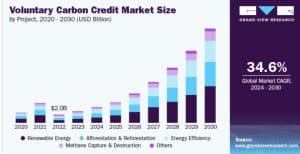
This remarkable growth reflects increased corporate commitments to net-zero targets and growing investor interest in carbon markets. The market saw over 250 million carbon credits traded in 2023, representing a significant increase from previous years.
Despite the difficulties, analysts agree that participation in the voluntary carbon market is growing rapidly. Even at the rate of growth depicted above, the voluntary carbon market would still fall significantly short of the amount of investment required for the world to fully meet the targets set out by the Paris Agreement.
6. How to Produce Carbon Credits
Many different types of businesses can create and sell carbon credits by reducing, capturing, and storing emissions through different processes.

Some of the most popular types of carbon offsetting projects include:
- Renewable energy projects,
- Improving energy efficiency,
- Carbon and methane capture and sequestration
- Land use and reforestation.
Renewable energy projects have already existed long before carbon credit markets came into vogue. Many countries in the world are blessed with a natural wealth of renewable energy resources. Countries such as Brazil or Canada that have many lakes and rivers, or nations like Denmark and Germany with lots of windy regions. For countries like these, renewable energy was already an attractive and low-cost source of power generation, and they now provide the added benefit of carbon offset creation.
Energy efficiency improvements complement renewable energy projects by reducing the energy demands of current buildings and infrastructure. Even simple everyday changes like swapping your household lights from incandescent bulbs to LED ones can benefit the environment by reducing power consumption. On a larger scale, this can involve things like renovating buildings, optimizing industrial processes to make them more efficient, or distributing more efficient appliances to the needy.
Carbon and methane capture involves implementing practices that remove CO2and methane (which is over 20 times more harmful to the environment than CO2) from the atmosphere.
Methane is simpler to deal with, as it can simply be burned off to create CO2. While this sounds counterproductive at first, since methane is over 20 times more harmful to the atmosphere than CO2, converting one molecule of methane to one molecule of CO2 through combustion still reduces net emissions by more than 95%.
For carbon, capture often happens directly at the source, such as from chemical plants or power plants. While the injection of this captured carbon underground has been used for various purposes like enhanced oil recovery for decades already, the idea of storing this carbon long-term, treating it much like nuclear waste, is a newer concept.
Land use and reforestation projects use Mother Nature’s carbon sinks, the trees, and soil, to absorb carbon from the atmosphere. This includes protecting and restoring old forests, creating new forests, and soil management.
Plants convert CO2 from the atmosphere into organic matter through photosynthesis, which eventually ends up in the ground as dead plant matter. Once absorbed, the CO2-enriched soil helps restore the soil’s natural qualities – enhancing crop production while reducing pollution.
6.1 Who Verifies Carbon Credits?
Visit our article here on how carbon credits are verified by the market.
The carbon credit verification landscape has evolved with new standards emerging. Beyond established verifiers like Verra and Gold Standard, the Integrity Council for the Voluntary Carbon Market (IC-VCM) launched its Core Carbon Principles in 2024, setting new global threshold standards for high-quality carbon credits.
Likewise, the Science Based Targets initiative (SBTi) has also introduced enhanced verification protocols for corporate net-zero claims.
7. How Companies Can Offset Carbon Emissions
There are countless ways for companies to offset carbon emissions.
Though not a comprehensive list, here are some popular practices that typically qualify as offset projects:
- Investing in renewable energy by funding wind, hydro, geothermal, and solar power generation projects, or switching to such power sources wherever possible.
- Improving energy efficiency across the world, for instance by providing more efficient cookstoves to those living in rural or more impoverished regions.
- Capturing carbon from the atmosphere and using it to create biofuel, makes it a carbon-neutral fuel source.
- Returning biomass to the soil as mulch after harvest instead of removing or burning. This practice reduces evaporation from the soil surface, which helps to preserve water. The biomass also helps feed soil microbes and earthworms, allowing nutrients to cycle and strengthen soil structure.
- Promoting forest regrowth through tree-planting and reforestation projects.
- Switching to alternate fuel types, such as lower-carbon biofuels like corn and biomass-derived ethanol and biodiesel.
If you’re wondering how carbon offset and allotment levels are valued and determined through these processes, take a deep breath. Monitoring emissions and reductions can be a challenge for even the most experienced professional.