CCS CO2 Pipelines: A Triple 48 Inch Reality Check
Thank you Saundra for Sharing this article with FSF!
Climate Investigations Center

Credit: https://climateinvestigations.org/ccs-co2-pipelines-a-triple-48-inch-reality-check/
I have been calling the carbon capture CO2 pipeline buildout plan a “publicly-funded sewer system for the fossil fuel industry” for some time. In fact it’s their only lifeline, and in the meantime it’s also really good for greenwashing and TV ads.
A reality check is in order. New analysis here of a major report published by Princeton in 2020-21 reveals a “blueprint” for a cutting carbon emissions that includes a Trans-Alaska Pipeline sized transmission pipeline running from New Jersey to Georgia and two or three 48 inch diameter pipelines running in tandem, for hundreds of miles, down the Ohio and Mississippi valleys and across the south.
The Princeton mapping exercises have no apparent consideration of people who happen to be in the way. They are aimed at the cheapest solution, the least-cost, shortest distance between two points the pollution source and the dump. The CO2 pipeline buildout is shaping up to be the biggest environmental justice insult ever. Because where will these pipelines be built? Through communities and over people’s land who don’t have the clout to stop them.
An unspoken global dilemma with the pipe dream of Carbon Capture and Storage (CCS) is this: the carbon pollution coming out of smokestacks at power plants, refineries, chemical plants, cement kilns, steel mills and ethanol plants is often nowhere near the proposed CO2 dumps – deep saline aquifers geologists have scoped out and where people theorize we can put the multi gigaton CO2 genie back in the bottle.
Meanwhile, the concept of CCS has become a central to “Net Zero” pledges by corporations and governments around the world, including the Biden Administration. The notion has been around for over 50 years, but the legacy, viewed with unbiased goggles, is one of colossal project failures.
NOTE: This blog is not detailing the many many other problems with CCS – the massive buildout of new chemical facilities on top of old dirty industries in underserved communities, the wasted energy needed to execute the “capture” and compression of CO2, the massive quantities of new chemicals needed, the disposal of millions of gallons of toxic brine that must be pumped to the surface from the saline aquifers to make room for the CO2, to avoid causing earthquakes and on and on. For more on those problems see CarbonCaptureFacts and the Center for International Environmental Law for starters.
Here we are talking about a basic practical question: what would it take to build a “sewer system” big enough to handle the carbon dioxide that polluters are currently dumping for free in the atmosphere? What would that pipeline network look like in real life?
Princeton Net Zero America report 2020-21
Shortly after Biden won the Presidency, Princeton University published a 350 slide powerpoint deck and lots of data in a report called Net Zero America, a really ambitious piece of work to back up the Biden campaign pledges around climate change. It looks like an actual “plan” to overhaul our energy infrastructure and help decarbonize our economy, which is the goal.
The Net Zero America Report has a whole section on CO2 pipelines because of course you have to tackle this question if you are serious Princeton-level thinker. The Princeton modelers determined that we need system of pipelines totaling up to 68,972 miles (111,000 km) at a cost if $135 Billion dollars by 2050. A JP Morgan analyst took a close look at the Princeton figures and concluded that the proposed massive buildout of CO2 pipeline and CCS infrastructure would unfortunately only capture 15% of current US greenhouse gas emissions:

In 2007, Lee Raymond, former ExxonMobil CEO made a similar cynical point about the scale of effort that would be involved to build out CCS pipelines. Someone at Exxon had done the math 20 years ago. Speaking just about coal fired power plants Raymond said:
“…if you tried to inject all the supercritical CO2 that came from all the coal-fired power plants you end up moving more liquids than the oil and gas industry moves today, just for CO2. So it is a huge, huge undertaking. And, again, people — this gets into a lot of the infrastructure issues, people just assume that that can happen. You can’t assume that’s going to happen. And the cost is going to be very, very significant.”
Nonetheless, the optimists at Princeton and CCS advocates in industry, academia and government envision an enormous amount of pipeline being installed in coming decades. Here are the Princeton maps of what needs to be done, downplaying it as smaller than natural gas infrastructure:
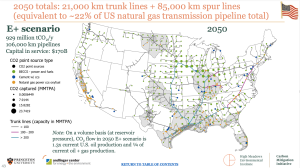
Note: On a volume basis (at reservoir pressure), COy flow in 2050 E+ scenario is 1.3x current U.S. oil production and ¼ of current oil + gas production. https://climateinvestigations.org/ccs-co2-pipelines-a-triple-48-inch-reality-check/
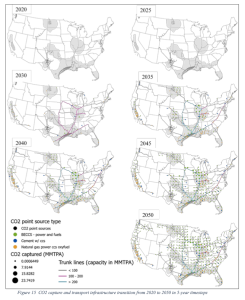
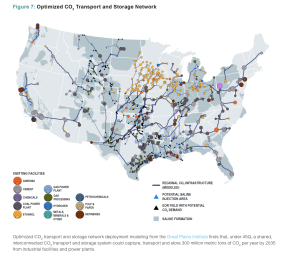
from: https://climateinvestigations.org/ccs-co2-pipelines-a-triple-48-inch-reality-check/
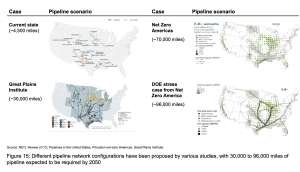
From: https://climateinvestigations.org/ccs-co2-pipelines-a-triple-48-inch-reality-check/
Read More: https://climateinvestigations.org/ccs-co2-pipelines-a-triple-48-inch-reality-check/
and look at the data reports for your states:
Iowa Data Report: https://netzeroamerica.princeton.edu/img/nzap-iowa-report.pdf
Illinois: https://netzeroamerica.princeton.edu/img/nzap-illinois-report.pdf
Kansas: https://netzeroamerica.princeton.edu/img/nzap-kansas-report.pdf
Nebraska:https://netzeroamerica.princeton.edu/img/nzap-nebraska-report.pdf
North Dakota: https://netzeroamerica.princeton.edu/img/nzap-north-dakota-report.pdf
Oklahoma: https://netzeroamerica.princeton.edu/img/nzap-oklahoma-report.pdf
South Dakota: https://netzeroamerica.princeton.edu/img/nzap-south-dakota-report.pdf